malloc
w9d1
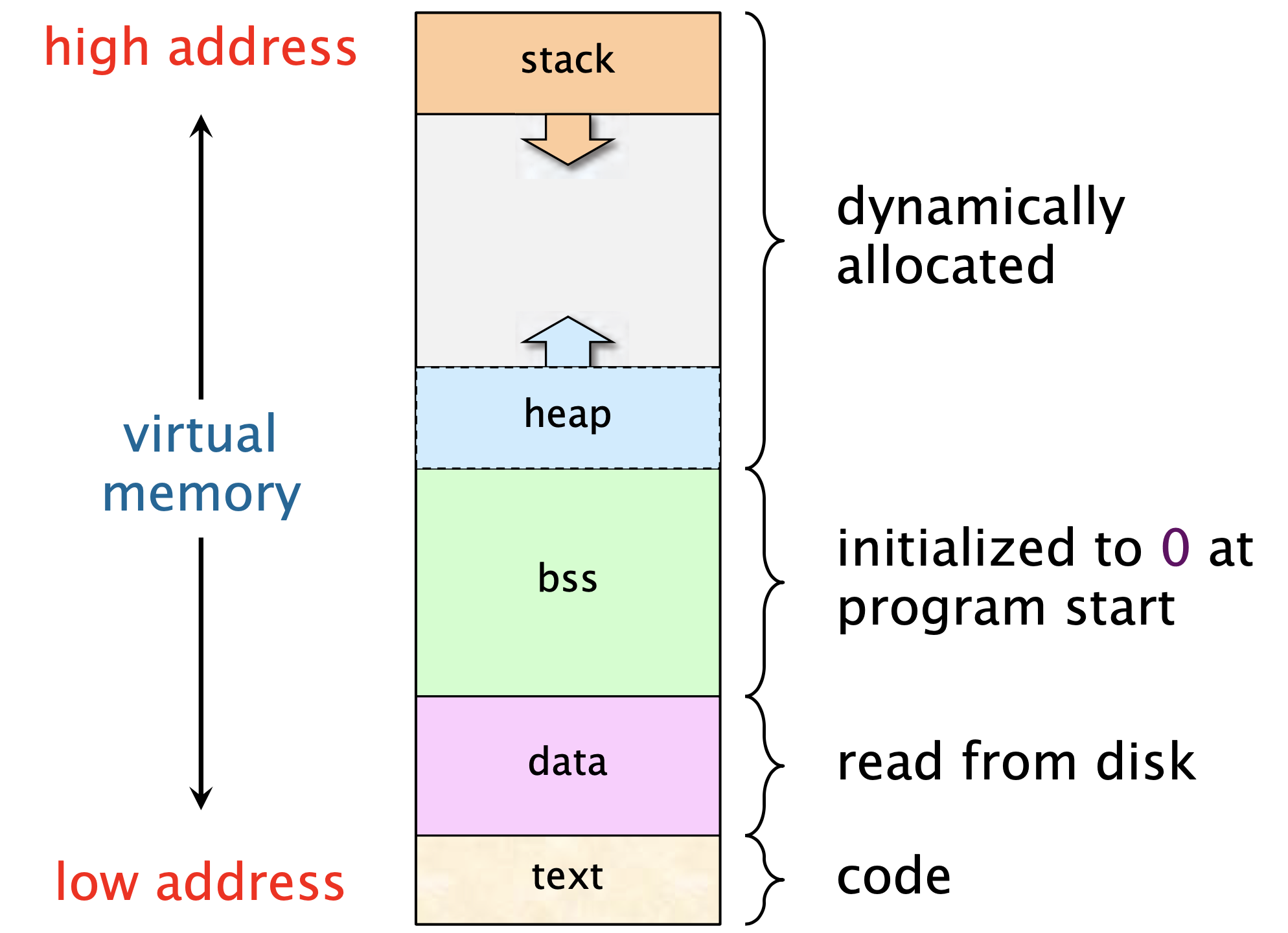
Memory layout
- stack: function variables, functions, globals
- heap: malloced variables
- Other stuff for an OS/compilers class
Stack
- Stack reserved when variables declared
- Why C89 requires declares before code
- Why declares require a type with a size.
- Regarded as “growing downwards” from large address to small.
Example
- Allocate
sizeof(int)bytes for variableafor functionmain- A is uninitialized, so the value is undefined.
- Compilers may initialize to a default value
- Assume they don’t.


Example
- Allocate
aformain - Allocate
sizeof(int)bytes for variablebfor functionmain- Store the numerical value
(int)-3in these bytes.
- Store the numerical value

Example
- Allocate
aformain - Allocate
bformain - Allocate
sizeof(int)bytes for variablecformain- Store the numerical value
(int)12345
- Store the numerical value

Function Call
- Allocate
aformain - Allocate
bformain - Allocate
cformain - Allocate
sizeof(int)bytes for variableafor hello- Store
(int)100 - Perhaps
hello.avsmain.a
- Store

What of return
- Deallocate the function’s stack.
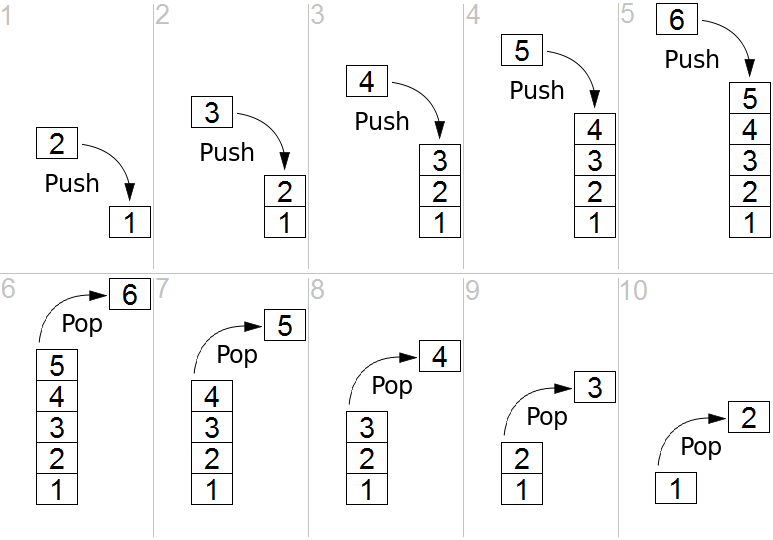
- “Stack push” the return value.
aalready at the top (bottom) of the stack.- Still
100, no longerhello.a
- Still
What of return
- The calling function does a “stack pop”
- The “stack pop” is stored as
d - The
100never moves.- That’s why we use a stack.

Return
- Push
main.a - Push
main.b=3 - Push
main.c=12345 - Call
hello- Push
hello.a=100 return
- Push
- Pop
a’s value into intomain.d

Stack Discussion?
Heap Example
- Three operations.
- Stack-allocate
sizeof(int *)bytes formain.p. - Heap-allocate
sizeof(int)bytes - Store the address in
p.
- Stack-allocate

- As a reference, we denote this with an arrow rather than by showing a value.
Heap Example
*pis the value of the bits on the heap.- It is an
int - It is 4 bytes
- It is an
pis the value of the bits on the stack.- It is an
int *orvoid * - It is 8 bytes
- It is an
Heap Example
- Malloc
- Store
0atmain.p- Or store
0at the location described bymain.p - Not a push operation!
- Or store

Heap Example
- Stack-allocate
main.q - Heap-allocate
2 * sizeof(int)bytes - Make a note that they are
ints - Store the address in
main.q.

Heap Example
- Malloc
p - Store
0atmain.p - Malloc
q
Heap Example
- Malloc
p - Store
0atmain.p - Malloc
q - Store
1atmain.q

Heap Example
- Malloc
p - Store
0atmain.p - Malloc
q - Store
1atmain.q - Store
2at index1of theintarray which begins atmain.q

Heap Example
- Malloc
p - Store
0atmain.p - Malloc
q - Store
1atmain.q - Store
2inmain.q[1] - Store the value of
main.q(a location) inmain.p

Heap Example
- Malloc
p - Store
0atmain.p - Malloc
q - Store
1atmain.q - Store
2inmain.q[1] - Store the value of
main.q(a location) inmain.p
Free
- p holds address of the heap location holding the integer value
0. - q holds address of the heap location holding the integer array value
1.- Same location as integer array
{1, 2}in this case.
- Same location as integer array
Memory Leak
- p holds a *_Nullable.
- q holds a *_Nullable.
Memory Leak
- p, q holds a *_Nullable.
- “old
p” forgotten!
Instead
free(p)and the bytes return to circulation.0persists until overwritten*

Pointer Arithmetic
- Wait a minute…
sizeof(int) != 1. - So
qis must be some value other than1away fromq[1] - Yet we do not address the next int in an array by saying
q[1*sizeof(int)]