Ada & Alan
AI 101
Introduction to AI
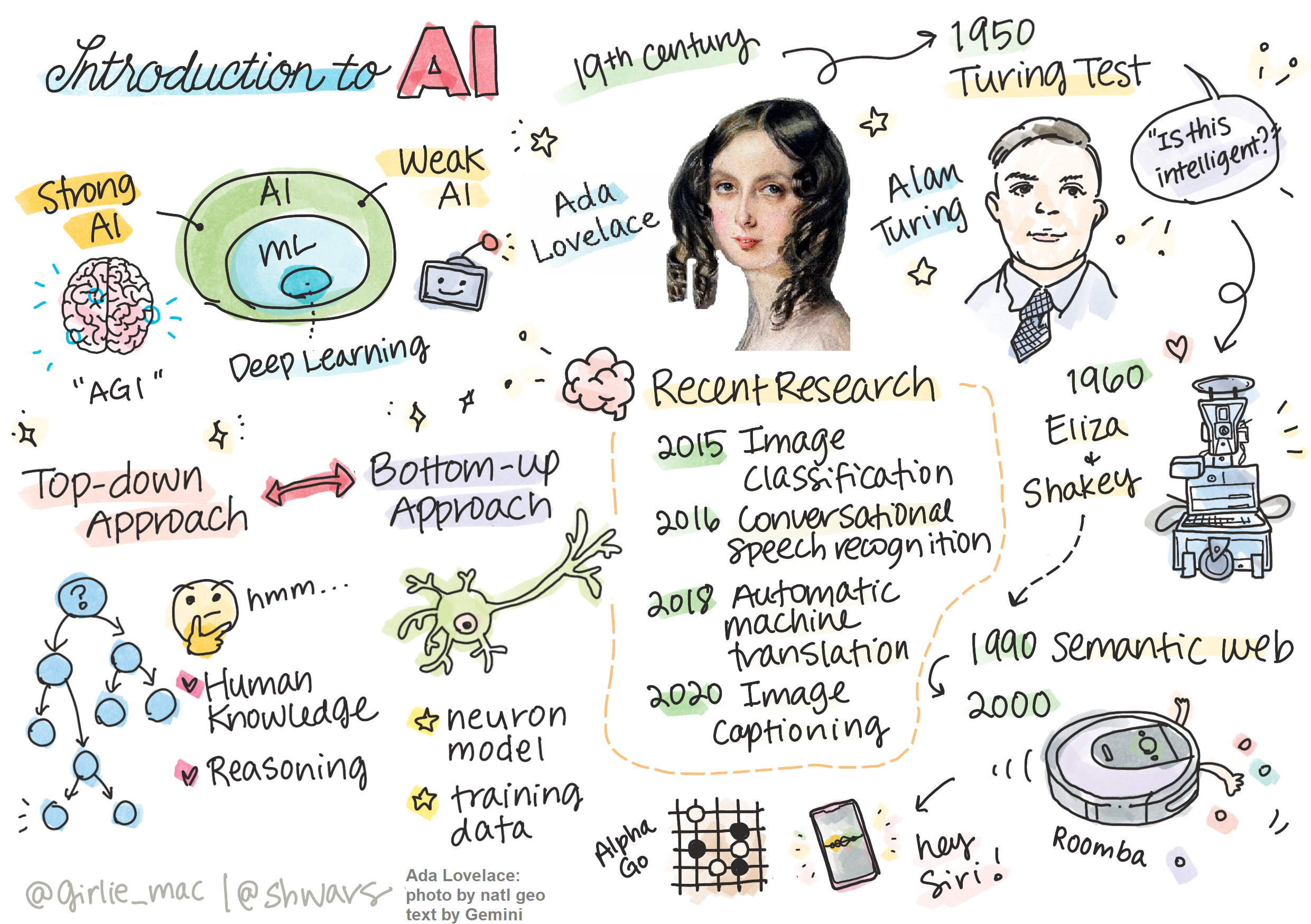
Sketchnote by Tomomi Imura. Edits by Prof. Calvin
What is AI?
Working Definition
Artificial Intelligence is a scientific discipline that studies how we can make computers exhibit intelligent behavior, e.g. do those things that human beings are good at doing.
- Scientific - uses experimentation, publication, and falsification.
- Computers - based on the existing fields of computer science but also linguistics, philosophy, mathematics, and physics (or perhaps electrical engineering)
- Humans - measured against a human baseline
Computers
- Originally, programming was discovered by Ada Lovelace to operate on numbers following a well-defined procedure - an algorithm - like a recipe or knitting pattern.
- Modern computers are theoretical identical (through practically quite distinct)
- Thus it is possible to program a computer to do something if we know the exact sequence of steps that we need to do in order to achieve the goal.
How many years old?
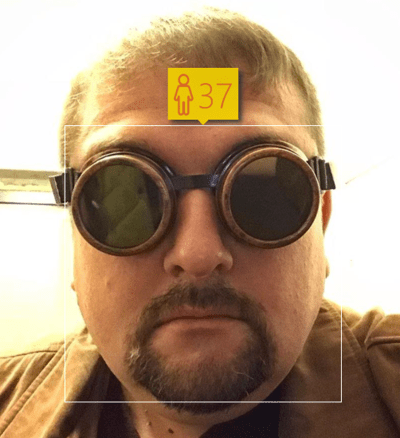
Photo by Vickie Soshnikova
Intelligence?
- Defining the age of a person from their photograph is a task that cannot be explicitly programmed
- We do not know how we come up with a number inside our head when we do it!
- Oftentimes we wish to avoid estimating age…
- Hire/fire decisions, most notably!
Which is more beautiful?
Elowah Falls

Fairy Falls

Intelligence?
- There are some tasks that we do not explicitly know how to solve.
- Consider determining the age of a person from their photograph.
- We somehow learn to do it, because we have seen many examples of people of different age, but we cannot explicitly explain how we do it, nor can we program the computer to do it.
- This is exactly the kind of task that are of interest to Artificial Intelligence (AI for short).
Think/Pair/Share
✅ Think of some tasks that one may wish to offload to AI.
- Consider the fields like education, politics, medicine, and the arts.
- How are these fields interacting today with AI?
- Who benefits from the use of AI and who pays the costs?
Weak AI vs. Strong AI
- Early AI research differentiated two forms of AI
- Dicussion of the forms has become a much more popular distinction with the emergence of entreprise grade chatbots beginning with OpenAI ChatGPT
| Weak AI | Strong AI |
|---|---|
| Weak AI refers to AI systems that are designed and trained for a specific task or a narrow set of tasks. | Strong AI, or Artificial General Intelligence (AGI), refers to AI systems with human-level intelligence and understanding. |
| Weak AI | Strong AI |
|---|---|
| These AI systems are not generally intelligent; they excel in performing a predefined task but lack true understanding or consciousness. | These AI systems have the ability to perform any intellectual task that a human being can do, adapt to different domains, and possess a form of consciousness or self-awareness. |
| Weak AI | Strong AI |
|---|---|
| Examples of weak AI include virtual assistants like Siri or Alexa, recommendation algorithms used by streaming services, and chatbots that are designed for specific customer service tasks. | Achieving Strong AI is a long-term goal of AI research and would require the development of AI systems that can reason, learn, understand, and adapt across a wide range of tasks and contexts. |
| Weak AI | Strong AI |
|---|---|
| Weak AI is highly specialized and does not possess human-like cognitive abilities or general problem-solving capabilities beyond its narrow domain. | Strong AI is currently a theoretical concept, and no AI system has reached this level of general intelligence. |
Definitions
- One of the problems when dealing with the term “Intelligence” is that there is no clear definition of this term.
- One can argue that intelligence is connected to abstract thinking, or to self-awareness, but we cannot properly define it.
Intelligence?

Photo by Prof. Calvin
To see the ambiguity, try answering a question: “Is this cat (Ursula) intelligent?”
- (She is)
- (She is VERY smart)
Consider…
- Different people tend to give different answers to this question, as there is no universally accepted test to prove the assertion is true or not.
- And if you think there is - try an IQ test… What could go wrong.
By the way…
- It is common for IQ to enter conversations as a throwaway line in discussion of AI.
Think/Pair/Share
✅ Think for a minute about how you define intelligence.
- Is a crow who can solve a maze and get at some food intelligent?
- Is a traffic light intelligent?
- Is an ecosystem intelligent?
- Is a character in a novel or play?
The Turing Test
- When speaking about AI we need to have some way to tell if we have created a truly intelligent system.
- Alan Turing proposed a way called a Turing Test, which also acts like a definition of intelligence.
- Alan Turing the 🐐
- The test compares a given system to something inherently intelligent - a real human being, and because any automatic comparison can be bypassed by a computer program, we use a human interrogator.
Aside on Turing
- Turing, by cracking the enigma code used by Nazi war criminals, can be regarded as almost single-handedly winning the Western front for the allies in WWII.
- Turing was prosecuted by the British Empire for his sexuality until his death at 41 in 1953.
- Ask me how I feel about this but not during class.
Eugene Goostman
- One path to intelligence? Cheat!
A chat-bot called Eugene Goostman, developed in St. Petersburg, came close to passing the Turing test in 2014 by using a clever personality trick. It announced up front that it was a 13-year old Ukrainian boy, which would explain the lack of knowledge and some discrepancies in the text. The bot convinced 30% of the judges that it was human after a 5 minute dialogue, a metric that Turing believed a machine would be able to pass by 2000. However, one should understand that this does not indicate that we have created an intelligent system, or that a computer system has fooled the human interrogator - the system didn’t fool the humans, but rather the bot creators did!
✅ Have you ever been fooled by a chat bot into thinking that you are speaking to a human? How did it convince you?
Syllabus
- Bring a computer with internet access on Wednesday.
- Join the Discord - I owe you an email.
- Check out the syllabus