+6867013973900411596
+8365149213218041209
-7359268418824735774
+8940059892167012834
+3281117529963993518SHA256
0x1.3
Announcements
- Welcome to Computing Security
- Action Items:
- How was Macros?
- Next homework - SHAinC
Today
- SHA256
- Why?
- What?
- How?
Slide Credit
- Saravanan Vijayakumaran
- sarva@ee.iitb.ac.in
- Department of Electrical Engineering
- Indian Institute of Technology Bombay
Why?
Hash Functions
- Methods for deterministically compress a long input string to a shorter output called a digest
- Also called “signature”
- Can hash anything stored in computer
- These are also called “compression” or “one-way” hash functions.
Hash Merits
- Primary requirement is that it should be infeasible to find collisions,
- i.e. no two inputs have same digest.
- If I download Ubuntu and check the signature, I should know it’s Ubuntu.
- If Ubuntu and a malware package have the same signature, useless.
Non-Cryptographic
- Used to build hash tables
- Key-value stores with \(\mathcal{O}(1)\) lookup time.
- My hashtable/hashmap slides
- Example: Python
hash
Example.tex
- Let \(M\) be the size of some hash table
- Take \(a \in \mathbb{N} : a < M \land \gcd(a, M) = 1\)
- That is, two positive coprime integers.
- Any integer value \(x\) can be mapped into \(\mathbb{N}/(M) = \{0,1,\ldots, M-1\}\)
\[ h_a(x) = a x \pmod{M} \]
Example.py
- We can express in a programming language.
- We note that 257 == 0x101 is prime.
- And therefore \(\forall M : \gcd(257,M) = 1\)
Example.c
- We note a high performance special case.
- Let \(w\) be the bit size used to store numbers
- Likely 32 == 0x20 for C
unsigned - \(W\) stands for word size
- Likely 32 == 0x20 for C
- Take \(W = 2^w\) and \(M = 2^m\)
Collisions
- A collision occurs if \[ \exists x, x' : x \neq x' \land h(x) = h(x') \]
- That is, this assertion fails:
- Goal: minimize:non-crypto::avoid:crypto collisions.
- Achieve this via a large codomain for \(h\)
Codomain:
Test it:
- As a rule we shouldn’t try to write proofs/definitions in Python, but…
- Small \(M = 2^{0x08} = 256\) means our computer can handle all possibilities.
Visualize:
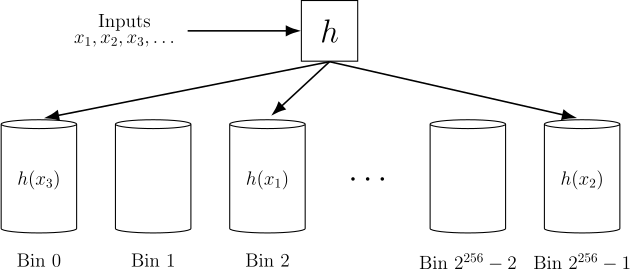
What?
Cryptographic
- Begin with SHA-2 (Secure Hash Algorithm 2).
- A family of cryptographic hash functions.
- By the U.S. National Security Agency (NSA)
- Published by the U.S. National Institute of Standards and Technology (NIST) in 2001.
Context
- SHA-1, released in 1995, found to have significant vulnerabilities.
- Growing concerns about the security of SHA-1 led to the development of SHA-2.
- SHA-3 released in 2015, not in wide use.
- For if weakness in SHA-2 discovered.
- SHA-2 regarded as secure in 2025.
Family
- Six hash functions release August 2001:
- SHA-224
- SHA-256
- SHA-384
- SHA-512
- SHA-512/224
- SHA-512/256
Adoption and Usage
- SHA-2 has been widely adopted in
- Digital signatures
- Certificate validation
- File integrity verification.
- Blockchain:
- 1 of ~2 core technologies of Bitcoin
- SHA-256 specifically
SHA-2 Pledge
- I need a verbal confirmation:
- Even though we will implement cryptography…
- We assume their insecurity as we learn to:
- Test our code
- Write proofs
- Use compilers
- We don’t know what side channel attacks are.
- I say: out-of-scope.
SHA-256 Overview
- SHA-2 with a 256-bit output length
- Accepts bit strings of length up to \(2^{64} - 1\)
- ~20 quintillion bits
- ~17 million terabytes
How?
Two Stages
- Output calculation has two stages:
- Preprocessing
- Hash Computation
Preprocessing
- A 256-bit state variable \(H^{(0)}\) is initialized:
\[\begin{align*} \begin{split} H_0^{(0)} = \texttt{0x6A09E667}, \quad H_1^{(0)} = \texttt{0xBB67AE85},\\ H_2^{(0)} = \texttt{0x3C6EF372}, \quad H_3^{(0)} = \texttt{0xA54FF53A},\\ H_4^{(0)} = \texttt{0x510E527F}, \quad H_5^{(0)} = \texttt{0x9B05688C},\\ H_6^{(0)} = \texttt{0x1F83D9AB}, \quad H_7^{(0)} = \texttt{0x5BE0CD19}. \end{split} \end{align*}\]
- “Fractional parts of square roots of first primes”
Input Padding
The input \(M\) is padded to a length that is a multiple of 512.
Let \(M\) be \(l\)-bits long.
Find the smallest non-negative \(k\) such that: \[ k + l + 65 \equiv 0 \pmod{512} \]
Padding Content
- Append \(k + 65\) bits to \(M\):
- A single one (
1), followed by - \(k\) zeros (
0), followed by - The 64-bit representation of \(l\). \[ \begin{align*} 1\underbrace{000 \cdots 000}_{k \textrm{ zeros}}\underbrace{l}_{\textrm{ 64 bits}} \\ \end{align*} \]
- A single one (
Example.py
- We can solve numerically in Python, but…
- Perhaps easier to show with strings.
M = "Hello there I am a message.  " * 15
l = len(M.encode('utf-8')) * 8
k = 512 - (l + 65) % 512
"l=", l, "k=", k, "pad=", "0x1" + "0" * (k//4) + f"{l:016x}" ## 64 // 4 == 16
('l=', 3480, 'k=', 39, 'pad=', '0x10000000000000000000000d98')- The arithmetic form is left an exercise for the interested student.
- My solution was 10-20 characters of code.
Hash Computation
- Padded input is split into \(N\) 512-bit blocks:
- We note this is 1-indexed, by convention. \[ M^{(1)}, M^{(2)}, \ldots, M^{(N)} \]
- When testing, expect to have only \(M^{(1)}\)
- 512 is a lot of bytes to e.g. type in.
- Test more once it works.
Hash Type
- The hash function has the following type: \[ f: M:\{0,1\}^{512} \times H:\{0,1\}^{256} \rightarrow H':\{0,1\}^{256} \]
- Given \(H^{(i-1)}\), calculate \(H^{(i)}\) using: \[
H^{(i)} = f(M^{(i)}, H^{(i-1)}), \quad 1 \leq i \leq N.
\]
- 1-indexed
Words
- We specify bitwise operations over exactly 32 bit words.
- The industry standard is to use
stdint
Operations
- Bitwise logical operations
- Unary,
- Binary, and
- Ternary, and
- Shift/rotate operations
- Simple, and
- Composite
Words
- Bitwise logical operations accept 1, 2, or 3 words of size 32 (
uint32_t) and produce one word.- Term these words \(U\), \(V\), \(W\)
- Shift/rotate operations additionally accept one natural number \(n\) < 32.
- Term this \(n\)
Unary Bitwise
- There is only one:
- ‘bitwise complement’/‘bitwise logical not’: \[ \lnot U \]
- Expressible with
uint32_tin C:
Binary Bitwise
- \(U \land V\), \(U \lor V\), \(U \oplus V\): AND, OR, XOR
- As from printb/macros.
Addition
- C addition is a binary bitwise operation:
- Equivalent to integer sum module \(2^{32}\)
from ctypes import c_uint ## this won't work in pypy
def addition(u:c_uint, v:c_uint) -> c_uint:
    return c_uint(u + v)

addition(4000000000, 4000000000) , addition(4, 4)
(c_ulong(3705032704), c_ulong(8))- For me, Python coerces
c_uinttoc_ulong.- Good reason to use C
C Math
- C addition on
uint32_tis already modulo \(2^{32}\)- What else would it be?
- Finite number of bits means finite values.
C Math
- We get the same values as the Python
c_uint - Python is written in C:
Ternary Bitwise
CHOICEandMEDIAN, expressed logically: \[ \text{CHOICE}(U, V, W) = (U \land V) \oplus (\lnot U \land W) \] \[ \text{MEDIAN}(U, V, W) = (U \land V) \oplus (U \land W) \oplus (V \land W) \]- There exist numerous formulations of median.
- This one lifted from GitHub user B-Con
Shifts/Rotates
- Compared to bitwise, they:
- Still work on a 32 bit word, but
- Also work on a value \(n : 0 \leq n \leq 31\)
- Or,
Simple Shift/Rotate
- Bitwise shift right
>>/ x86shrl\[ \textsf{SHR}^n(U) = \underbrace{000 \cdots 000}_{n \textrm{ zeros}} u_0 u_1 \cdots u_{30-n} u_{31-n} \] - The
ROTATEmacro / x86rorl\[ \textsf{ROTR}^n(U) = \underbrace{u_{32-n} u_{33-n} \cdots u_{30} u_{31}}_{n \textrm{ bits}} u_0 u_1 \cdots u_{30-n} u_{31-n} \]
Composites
- While not required…
- …easier to understand SHA256 with composites: \[ \begin{align*} \Sigma_0(U)&= \textsf{ROTR}^{02}(U) \oplus \textsf{ROTR}^{13}(U) \oplus \textsf{ROTR}^{22}(U) \\ \Sigma_1(U)&= \textsf{ROTR}^{06}(U) \oplus \textsf{ROTR}^{11}(U) \oplus \textsf{ROTR}^{25}(U) \\ \sigma_0(U)&= \textsf{ROTR}^{07}(U) \oplus \textsf{ROTR}^{18}(U) \oplus \textsf{SHR}^{03}(U) \\ \sigma_1(U)&= \textsf{ROTR}^{17}(U) \oplus \textsf{ROTR}^{19}(U) \oplus \textsf{SHR}^{10}(U) \end{align*} \]
- Macros and helper functions both work well here.
Hash Computation
- 4 steps for each 512 bit chunk.
- First chunk, also use pre-computed \(H\) values.
- Called, say “initial hash values”
- Successive chunks use previous chunk’s hash
- All chunks share pre-computed \(K\) values.
- Called, say “round contants”
- “Fractional parts of cube roots of first primes”
Parts
- Preprocess
- Set Message Schedule Array
- 64 word array
- Set Working Variables
- 8 word sized variables
- Main Loop
- Word level operations
- Update hash value
1. Set Message Schedule Array
- \(M^{(i)}_j\) is the \(j\)-th 0-indexed 32 bit word of the \(i\)-th 1-indexed 512 bit chunk of message \(M\)
- A word is 4 letters
- A chunk is short tweet (64 chars)
- \(M\) can be, e.g., Linux, the Iliad
\[ W_j = \begin{cases} M^{(i)}_j & 0 \leq j \leq 15 \\ \sigma_1(W_{j-2}) + W_{j-7} + \sigma_0(W_{j-15}) + W_{j-16} & 16 \leq j \leq 63 \end{cases} \]
2. Set Working Variables
- Initialize eight 32-bit words based on the prior hash. \[ (A, B, C, D, E, F, G, H) = (H^{(i-1)}_0, \ldots, H^{(i-1)}_7). \]
3. Main Loop
- Iterate \(j = 0\) to \(63\):
- Precompute two temporary values (or not) \[ \begin{align} \begin{split} & T_1 = H + \Sigma_1(E) + \textsf{CHOICE}(E,F,G) + K_j + W_j \\ & T_2 = \Sigma_0(A) + \textsf{MEDIAN}(A,B,C) \\ \end{split} \end{align} \]
- Update the working variables \[ (A,B,C,D,E,F,G,H) = (T_1+T_2, A, B, C, D+T_1, E, F, G) \]
4. Update hash value
- Conclude the work on \(M^{(i)}\) by finding \(H^{(i)}\)
\[ H^{(i)}_j = A + H^{(i-1)}_j, \quad j = 0, \ldots, 7 \]
Resources
- Wikipedia Pseudocode
- I used this to implement.
- Saravanan Vijayakumaran’s Slides
- I used this to typeset the slides.
- @manceraio’s .js demo
- Inspired my text-only Enigma.