---
title: Stream
subtitle: "w9d0"
---
## Announcements
- **Welcome** to Systems in C
- A quick digression on patterns & antipatterns
- C relevant
## Final
- The final is a write-up with supporting code.
- Let's review [`BTCinC`](btcinc.html).
## Today
- Antipatterns
> An anti-pattern in software engineering, project management, and business processes is a common response to a recurring problem that is usually ineffective and risks being highly counterproductive.
## Today
- Duplication
- Deficient encapsulation v. Broken modularization
- Magic Numbers
- Overthinking
- Big Ball of Mud v. God Object
- Data clump
# Duplicate
## Duplication
- And *streaming*
- Today's lecture inspire by the idea of *streaming data*
- Huge paradigm change in exascale data application, built the modern cloud.
- Let's look at two examples.
## Duplicate
- Say we are working on Base85 and have the following function:
```{.c}
void print_in_base85(uint32_t word);
```
- We know:
- Base85 prints exactly 5 characters of printable ascii/utf-8 for exactly every 4 bytes / 32 bits of data
- We know that every single 32-bit word is independent.
## Base85
- It is perhaps impossible but certainly "wrong" to perform base85 encoding without this function.
- So no matter what, we will have this function in some loop over some data.
```{.c}
do {
    print_in_base85(word);
} while ( conditional )
```
## Design Decision
- We have to decide how to populate `word`.
- We need 32 bits
- We need to read it from a file.
::::{columns}
:::{.column width=50%}
```{.c}
FILE *fp = fopen("file.txt", "r");
uint32_t word, conditional;
do {
    print_in_base85(word);
} while ( conditional )
```
:::
:::{.column width=50%}
```{.c}
FILE *fp = fopen("file.txt", "r");
uint32_t word, conditional;
do {
    print_in_base85(word);
} while ( conditional );
```
:::
::::
## Do we?
- Copy (duplicate) all data then read, or...
- Read 32 bits at a time
::::{columns}
:::{.column width=50%}
```{.c}
FILE *fp = fopen("file.txt", "r")
uint32_t words[∞], conditional, i = 0;
fread(words, ∞, 1, *fp);
do {
    print_in_base85(words[i++]);
} while ( conditional );
```
:::
:::{.column width=50%}
```{.c}
FILE *fp = fopen("file.txt", "r");
uint32_t word, conditional;
do {
    fread(word, 4, 1, fp);
    print_in_base85(word);
} while ( conditional );
```
:::
::::
## Stream!
::::{columns}
:::{.column width=50%}
- We never need local copies if we have independence!
- SHA256 - 512 bytes
- Base64 - 3 bytes
- Base85 - 4 bytes
- RSA - Fewer bytes than $n = pq$
:::
:::{.column width=50%}
```{.c}
FILE *fp = fopen("file.txt", "r");
uint32_t word, conditional;
do {
    fread(word, 4, 1, fp);
    print_in_base85(word);
} while ( conditional );
```
:::
::::
## Example
- From my research
- Wrote a Python script the handles some hardware design data.
- I use an existing tool in Java that handles the same data.
- I implemented by tool with *streaming*
## Timing
```{.email}
$ time python3 rtlkon.py testbench.vcd >/dev/null

real    0m0.323s
user    0m0.285s
sys     0m0.030s
$ time java daikon.Daikon testbench.decls testbench.dtrace >/dev/null

real    0m4.358s
user    0m14.128s
sys     0m0.413s
$ wc testbench.decls testbench.dtrace
    2219     4434    39059 testbench.decls
 2936134  2931732 17474090 testbench.dtrace
 2938353  2936166 17513149 total
```
## Stream
- Python 3, the world's slowest language, writes 15.5 MB in .323 seconds
- Java, the other slowest language, reads 15.5 MB in 14.128 seconds.
- Python at 48x speed
- Both tools fully simulate the processor as an automata, use local storage, etc.
## Visualize
- I think of streaming as follows.
- We image we want to make some "File B" from some "File A"
```{dot}
//| fig-width: 500px
//| echo: false
digraph finite_automata {
rankdir=LR;
bgcolor="#191919";
node [
fontcolor = "#ffffff",
color = "#ffffff",
shape=box
]
edge [
color = "#ffffff",
fontcolor = "#ffffff"
]
file1 [label="File A"];
file2 [label="File B"];
file1 -> file2;
}
}
```
## Visualize
- Imagine SHA hashing Pride and Prejudice
- You did this.
```{dot}
//| fig-width: 500px
//| echo: false
digraph finite_automata {
rankdir=LR;
bgcolor="#191919";
node [
fontcolor = "#ffffff",
color = "#ffffff",
shape=box
]
edge [
color = "#ffffff",
fontcolor = "#ffffff"
]
file1 [label="P&P"];
file2 [label="SHA"];
file1 -> file2;
}
}
```
## Visualize
- Imagine Base64 encoding an .svg.
- You can do this, quarto does this.
```{dot}
//| fig-width: 500px
//| echo: false
digraph finite_automata {
rankdir=LR;
bgcolor="#191919";
node [
fontcolor = "#ffffff",
color = "#ffffff",
shape=box
]
edge [
color = "#ffffff",
fontcolor = "#ffffff"
]
file1 [label="SVG"];
file2 [label="B64"];
file1 -> file2;
}
}
```
## Streaming
- A file contains of $n$ words of $b$ bits.
```{dot}
//| fig-width: 500px
//| echo: false
digraph finite_automata {
rankdir=LR;
bgcolor="#191919";
node [
fontcolor = "#ffffff",
color = "#ffffff",
shape=record
]
edge [
color = "#ffffff",
fontcolor = "#ffffff"
]
file1 [label="0x0 | 0x4 | 0x8 | 0xc"];
file2 [label="??? | ??? | ??? | ???"];
file1 -> file2;
}
}
```
## Streaming
- An executable maps files-to-files
- base64 is a bijection - remember those?
```{dot}
//| fig-width: 800px
//| echo: false
digraph finite_automata {
rankdir=LR;
bgcolor="#191919";
node [
fontcolor = "#ffffff",
color = "#ffffff",
shape=record
]
edge [
color = "#ffffff",
fontcolor = "#ffffff"
]
file1 [label="0x0 | 0x4 | 0x8 | 0xc"];
ELF [label="base64", shape=rarrow]
file2 [label="??? | ??? | ??? | ???"];
file1 -> ELF
ELF -> file2;
}
}
```
##
<table>
<tbody>
<tr>
<td>
**Bijective**
```{dot filename="Finite Automata"}
//| fig-width: 300px
//| fig-height: 200px
//| echo: false
digraph finite_automata {
rankdir=LR;
bgcolor="#191919";
node [
fontcolor = "#ffffff",
color = "#ffffff",
shape=circle,
]
edge [
color = "#ffffff",
fontcolor = "#ffffff"
]
subgraph cluster_X {
rankdir=TB;
color = "#ffffff";
fontcolor = "#ffffff"
style=rounded
label = "A";
"1";
"2";
"3";
"4";
}
subgraph cluster_Y {
rankdir=TB;
color = "#ffffff";
style=rounded
fontcolor = "#ffffff"
label = "B";
"w";
"x";
"y";
"z";
}
"1" -> "w";
"2" -> "x";
"3" -> "y";
"4" -> "z";
}
```
</td>
<td>
**Injective**
```{dot filename="Finite Automata"}
//| fig-width: 300px
//| fig-height: 200px
//| echo: false
digraph finite_automata {
rankdir=LR;
bgcolor="#191919";
node [
fontcolor = "#ffffff",
color = "#ffffff",
shape=circle,
]
edge [
color = "#ffffff",
fontcolor = "#ffffff"
]
subgraph cluster_X {
rankdir=TB;
color = "#ffffff";
fontcolor = "#ffffff"
style=rounded
label = "A";
"1";
"2";
"3";
}
subgraph cluster_Y {
rankdir=TB;
color = "#ffffff";
style=rounded
fontcolor = "#ffffff"
label = "B";
"w";
"x";
"y";
"z";
}
"1" -> "w";
"2" -> "x";
"3" -> "z";
}
```
</td>
</tr>
<tr>
<td>
**Surjective**
```{dot filename="Finite Automata"}
//| fig-width: 300px
//| fig-height: 200px
//| echo: false
digraph finite_automata {
rankdir=LR;
bgcolor="#191919";
node [
fontcolor = "#ffffff",
color = "#ffffff",
shape=circle,
]
edge [
color = "#ffffff",
fontcolor = "#ffffff"
]
subgraph cluster_X {
rankdir=TB;
color = "#ffffff";
fontcolor = "#ffffff"
style=rounded
label = "A";
"1";
"2";
"3";
"4";
}
subgraph cluster_Y {
rankdir=TB;
color = "#ffffff";
style=rounded
fontcolor = "#ffffff"
label = "B";
"w";
"x";
"y";
}
"1" -> "w";
"2" -> "x";
"3" -> "y";
"4" -> "y";
}
```
</td>
<td>
Neither
```{dot filename="Finite Automata"}
//| fig-width: 300px
//| fig-height: 200px
//| echo: false
digraph finite_automata {
rankdir=LR;
bgcolor="#191919";
node [
fontcolor = "#ffffff",
color = "#ffffff",
shape=circle,
]
edge [
color = "#ffffff",
fontcolor = "#ffffff"
]
subgraph cluster_X {
rankdir=TB;
color = "#ffffff";
fontcolor = "#ffffff"
style=rounded
label = "A";
"1";
"2";
"3";
"4";
}
subgraph cluster_Y {
rankdir=TB;
color = "#ffffff";
style=rounded
fontcolor = "#ffffff"
label = "B";
"w";
"x";
"y";
"z";
}
"1" -> "w";
"2" -> "x";
"3" -> "z";
"4" -> "z";
}
```
</td>
</tr>
</tbody>
</table>
## Base64
- Base64
- Bijects numbers in $\mathbb{Z}/n\mathbb{Z}:n = 2^{32}$
- To strings of length 5 over these symbols `[A-Za-z0-9+/]`
- Base64 encoding of a file
- Bijects files, we can think of as in binary, to
- Strings of arbitrary length over `[A-Za-z0-9+/]`
## Streaming
```{dot}
//| fig-width: 800px
//| echo: false
digraph finite_automata {
rankdir=LR;
bgcolor="#191919";
node [
fontcolor = "#ffffff",
color = "#ffffff",
shape=record
]
edge [
color = "#ffffff",
fontcolor = "#ffffff"
]
file1 [label="<a>0x0 | ??? | ??? | ???"];
ELF [label="base64", shape=rarrow]
file2 [label="<b>??? | ??? | ??? | ???"];
file1:a -> ELF
ELF -> file2:b;
}
```
## Streaming
```{dot}
//| fig-width: 800px
//| echo: false
digraph finite_automata {
rankdir=LR;
bgcolor="#191919";
node [
fontcolor = "#ffffff",
color = "#ffffff",
shape=record
]
edge [
color = "#ffffff",
fontcolor = "#ffffff"
]
file1 [label="???| <a>0x4 | ??? | ???"];
ELF [label="base64", shape=rarrow]
file2 [label="???| <b>0x5 | ??? | ???"];
file1:a -> ELF
ELF -> file2:b;
}
```
## Streaming
```{dot}
//| fig-width: 800px
//| echo: false
digraph finite_automata {
rankdir=LR;
bgcolor="#191919";
node [
fontcolor = "#ffffff",
color = "#ffffff",
shape=record
]
edge [
color = "#ffffff",
fontcolor = "#ffffff"
]
file1 [label="???| ??? | <a>0x8 | ???"];
ELF [label="base64", shape=rarrow]
file2 [label="??? | ??? |<b>0xA | ???"];
file1:a -> ELF
ELF -> file2:b;
}
```
## Streaming
```{dot}
//| fig-width: 800px
//| echo: false
digraph finite_automata {
rankdir=LR;
bgcolor="#191919";
node [
fontcolor = "#ffffff",
color = "#ffffff",
shape=record
]
edge [
color = "#ffffff",
fontcolor = "#ffffff"
]
file1 [label="???| ??? | ???| <a>0xC "];
ELF [label="base64", shape=rarrow]
file2 [label="??? | ??? | ???|<b>0xF "];
file1:a -> ELF
ELF -> file2:b;
}
```
## Pattern
- This is the pattern
```{dot}
//| fig-width: 800px
//| echo: false
digraph finite_automata {
rankdir=LR;
bgcolor="#191919";
node [
fontcolor = "#ffffff",
color = "#ffffff",
shape=record
]
edge [
color = "#ffffff",
fontcolor = "#ffffff"
]
file1 [label="...| <a>0xX |..."];
ELF [label="base64", shape=rarrow]
file2 [label="...|<b>0xY |... "];
file1:a -> ELF
ELF -> file2:b;
}
```
## Anti-Pattern
- This is the anti-pattern of duplication
```{dot}
//| fig-width: 1000px
//| echo: false
digraph finite_automata {
rankdir=LR;
bgcolor="#191919";
node [
fontcolor = "#ffffff",
color = "#ffffff",
shape=record
]
edge [
color = "#ffffff",
fontcolor = "#ffffff"
]
file1 [label="...| <a>0xX |..."];
fio [label="fread", shape=rarrow]
file15 [label="buf[∞]"];
ELF [label="base64", shape=rarrow]
file2 [label="...|<b>0xY |... "];
file1 -> fio
fio -> file15
file15 -> ELF
ELF -> file2:b;
}
```
## Big Deal
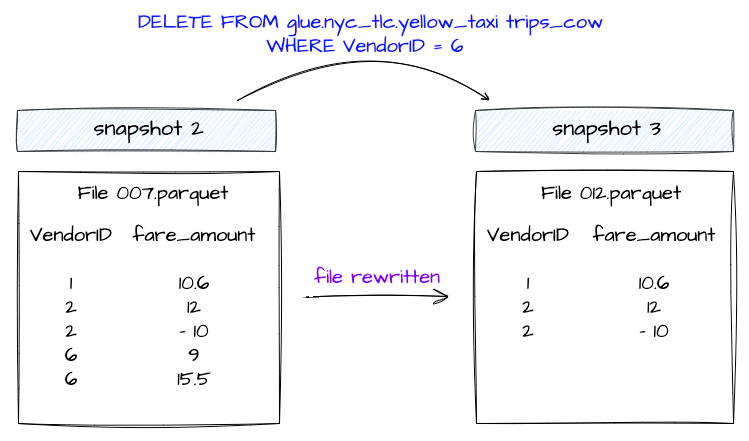
- Unnecessary duplication is a big deal in database / lakehouse.
{fig-align="center"}
## Big Deal
- Unnecessary duplication is what prevented prime generation in my 4096_t.
```{.C}
uint64_t bigdiv(uint64_t *num, uint64_t *den, uint64_t *quo, uint64_t *rem) {
    uint64_t i = getmsb(num), j = getmsb(den), n, d, tmq[S], tmr[S];
```
- That is `(4 + 2) * 64 * 64 = 24576` = 25 kilobytes for `5/2`
## Today
- ✓ Duplication
- Deficient encapsulation v. Broken modularization
- Magic Numbers
- Overthinking
- Big Ball of Mud v. God Object
- Data clump
# Encapsulate
## On 4096_t
- I needed the following on BigRSA
```{.C}
uint64_t bignul(uint64_t *a) {
    size_t i;
    for  (i = 0 ; i < S && !a[i]; i++) { }
    return i != S;
}
```
- I needed it on both `bigkey` and `bigrsa`
- I didn't inclode it in 4096_t
- I duplicated the code but...
## Header files
- This header file implements the 4096_t... dare I say... API?
```{.C}
void seebig(uint64_t *a);
uint64_t bigadd(uint64_t *in0, uint64_t *in1, uint64_t *sum);
uint64_t bigsub(uint64_t *min, uint64_t *sub, uint64_t *dif);
uint64_t bigmul(uint64_t *in0, uint64_t *in1, uint64_t *out);
uint64_t bigdiv(uint64_t *num, uint64_t *den, uint64_t *quo, uint64_t *rem);
uint64_t bigquo(uint64_t *num, uint64_t *den, uint64_t *quo);
uint64_t bigrem(uint64_t *num, uint64_t *den, uint64_t *rem);
```
- I shouldn't mess with this! It's already "released"!
## Options
- Implement `bignul` at the point-of-us, in both `bigrsa` and `bigkey`
- Broken modularization (big function outside of 4096_t)
- Duplication (in both files)
- Add `bignul` back into `4096_t.h`
- Broken modularization
- E.g., the tests on 4096_t don't test bignul
## Takeaways
- When we design libraries, software, APIs, test scripts...
- Make sure we are preserving modularization and enscapsulation
- Shouldn't have bigops scattered to the four winds
## Another example
- This function:
```{.c}
void print_in_base85(uint32_t word);
```
- Breaks here:
```{.c}
FILE *fp = fopen("file.txt", "r");
uint32_t word, conditional;
do {
    fread(word, 4, 1, fp);
    print_in_base85(word);
} while ( conditional );
```
- What is `conditional`?
## Return type
- This function:
```{.c}
/* returns ## of words read */
size_t print_in_base85(uint32_t word)
```
- Uses its return value:
```{.c}
FILE *fp = fopen("file.txt", "r");
uint32_t word;
size_t cond;
do {
    fread(word, 4, 1, fp);
    cond = print_in_base85(word);
} while ( 4 == cond );
```
- To *encapsulate* checking end of a file
## Bad
- These are both bad
::::{columns}
:::{.column width=50%}
```{.c}
void print_in_base85(uint32_t word)
```
```{.c}
size_t fp = fopen("file.txt", "r");
uint32_t word;
do {
    fread(word, 4, 1, fp);
    print_in_base85(word)
} while ( ??? )
```
:::
:::{.column width=50%}
```{.c}
size_t print_in_base85(uint32_t word)
```
```{.c}
size_t s, fp = fopen("file.txt", "r");
uint32_t word;
do {
    fread(word, 4, 1, fp);
    s = print_in_base85(word)
} while ( 4 == s )
```
:::
::::
## Another example
- `biggmp.c`, a libgmp implementation of 4096_t I am now providing for usage on `bigrsa`, could contain much repeated code.
## Add and Sub
- GMP works by:
- Declaring an `mpz_t` variable.
- Initializing with `mpz_init`
- Loading in data with `mpz_import`
- Performing some operation
- Extracting to a buffer or 4096_t with `mpz_export`
- Calling `mpz_clear` or slowing using up all your memory.
## See it
- Here's add with light edits:
::::{columns}
:::{.column width=50%}
```{.email}
Declaring an `mpz_t` variable.
Initializing with `mpz_init`
Loading in data with `mpz_import`
    (Twice)
Performing some operation
Extracting to a buffer or 4096_t with `mpz_export`
Calling `mpz_clear` or slowing using up all your memory.
```
:::
:::{.column width=50%}
```{.c}
void bigadd(uint64_t *in0, uint64_t *in1, uint64_t *sum) {
    mpz_t m0, m1;
    mpz_inits(m0, m1, NULL);
    mpz_import(m0, S, -1, sizeof(uint64_t), 0, 0, a);
    mpz_import(m1, S, -1, sizeof(uint64_t), 0, 0, b);
    mpz_add(m0,m0,m1);
    mpz_export(c, NULL, -1, sizeof(uint64_t), 0, 0, m0);
    mpz_clears(m0, m1, NULL);
}
```
:::
::::
## Both
- Only one line differs!
- 8 repeated lines!
- Would have to fix any bug in $n$ places!
::::{columns}
:::{.column width=50%}
```{.C}
void bigsub(uint64_t *in0, uint64_t *in1, uint64_t *dif) {
    mpz_t m0, m1;
    mpz_inits(m0, m1, NULL);
    mpz_import(m0, S, -1, sizeof(uint64_t), 0, 0, a);
    mpz_import(m1, S, -1, sizeof(uint64_t), 0, 0, b);
    mpz_sub(m0,m0,m1);
    mpz_export(c, NULL, -1, sizeof(uint64_t), 0, 0, m0);
    mpz_clears(m0, m1, NULL);
}
```
:::
:::{.column width=50%}
```{.c}
void bigadd(uint64_t *in0, uint64_t *in1, uint64_t *sum) {
    mpz_t m0, m1;
    mpz_inits(m0, m1, NULL);
    mpz_import(m0, S, -1, sizeof(uint64_t), 0, 0, a);
    mpz_import(m1, S, -1, sizeof(uint64_t), 0, 0, b);
    mpz_add(m0,m0,m1);
    mpz_export(c, NULL, -1, sizeof(uint64_t), 0, 0, m0);
    mpz_clears(m0, m1, NULL);
}
```
:::
::::
## Bug
- This doesn't work because `sum` is used unitialized
- Requires 2 edits, easy to miss one
::::{columns}
:::{.column width=50%}
```{.C}
void bigsub(uint64_t *in0, uint64_t *in1, uint64_t *dif) {
    mpz_t m0, m1;
    memset(dif, 0, BYTES);
    mpz_inits(m0, m1, NULL);
    mpz_import(m0, S, -1, sizeof(uint64_t), 0, 0, a);
    mpz_import(m1, S, -1, sizeof(uint64_t), 0, 0, b);
    mpz_sub(m0,m0,m1);
    mpz_export(c, NULL, -1, sizeof(uint64_t), 0, 0, m0);
    mpz_clears(m0, m1, NULL);
}
```
:::
:::{.column width=50%}
```{.c}
void bigadd(uint64_t *in0, uint64_t *in1, uint64_t *sum) {
    mpz_t m0, m1;
    memset(sum, 0, BYTES);
    mpz_inits(m0, m1, NULL);
    mpz_import(m0, S, -1, sizeof(uint64_t), 0, 0, a);
    mpz_import(m1, S, -1, sizeof(uint64_t), 0, 0, b);
    mpz_add(m0,m0,m1);
    mpz_export(c, NULL, -1, sizeof(uint64_t), 0, 0, m0);
    mpz_clears(m0, m1, NULL);
}
```
:::
::::
## Better
- Write some function that does all the setup and teardown
- Pass that function the operation as an argument
```{.c}
void apply(uint64_t *in0, uint64_t *in1, uint64_t *out, function) {
    mpz_t m0, m1;
    memset(sum, 0, BYTES);
    mpz_inits(m0, m1, NULL);
    mpz_import(m0, S, -1, sizeof(uint64_t), 0, 0, a);
    mpz_import(m1, S, -1, sizeof(uint64_t), 0, 0, b);
    function(m0,m0,m1);
    mpz_export(c, NULL, -1, sizeof(uint64_t), 0, 0, m0);
    mpz_clears(m0, m1, NULL);
}
```
## Code reuse!
```{.c}
uint64_t bigadd(uint64_t *in0, uint64_t *in1, uint64_t *sum) {
    apply(in0, in1, sum, mpz_add);
    return 0;
}

uint64_t bigsub(uint64_t *min, uint64_t *sub, uint64_t *dif) {
    apply(min, sub, dif, mpz_sub);
    return 0;
}

uint64_t bigmul(uint64_t *in0, uint64_t *in1, uint64_t *out) {
    apply(in0, in1, out, mpz_mul);
    return 0;
}
```
## In practice
- We declare a function which accepts a function as an argument by giving the functions type, and a local variable name.
- We call a function which "" by using the function name.
- `mpz_add` returns void and accepts 3 `mpz_t` arguments.
- Two are `const` which is out-of-scope for now
```{.C}
void (f)(mpz_t, const mpz_t, const mpz_t)
```
## Declare it:
```{.c}
void apply(void (f)(mpz_t, const mpz_t, const mpz_t), uint64_t *in0, uint64_t *in1, uint64_t *out) {
    mpz_t m0, m1;
    /* much text */
    return;
}
```
## Call it:
- This code is correct, just use name.
```{.c}
uint64_t bigmul(uint64_t *in0, uint64_t *in1, uint64_t *out) {
    apply(in0, in1, out, mpz_mul);
    return 0;
}
```
## Higher Order
- Oh by the way, this **encapsulates** libgmp.
- This encapsulation method is the function programming concept of higher order functions.
- They are great.
- Not fully supported in C 😭
- We can't *return* functions, just pass as args
- Oh by the way, this **encapsulates** libgmp.
## Today
- ✓ Duplication
- ✓ Deficient encapsulation v. Broken modularization
- Magic Numbers
- Overthinking
- Big Ball of Mud v. God Object
- Data clump
# Sorcery
##
{fig-align="center"}
## Who or what is "4"?
```{.c}
size_t s, fp = fopen("file.txt", "r")
uint32_t word;
do {
    fread(word, 4, 1, fp);
    s = print_in_base85(word)
} while ( 4 == s )
```
## Sizeof
```{.c}
size_t s, fp = fopen("file.txt", "r")
uint32_t word;
do {
    fread(word, sizeof(uint32_t), 1, fp);
    s = print_in_base85(word)
} while ( sizeof(uint32_t) == s )
```
## Define
- Add a define:
```{.c}
#define WORD_SIZE sizeof(uint32_t)
```
- By convention, as we know, all caps.
```{.c}
size_t s, fp = fopen("file.txt", "r")
uint32_t word;
do {
    fread(word, WORD_SIZE, 1, fp);
    s = print_in_base85(word)
} while ( WORD_SIZE == s )
```
## 4096_t
- I used defines to allow 4096_t to be changed to 8192 with a change to a single line of code
- *But this only works if you use the defines everywhere*
```{.C filename="4096_t.h"}
#define S (size_t)(4096 / 64)
#define BYTES S * sizeof(uint64_t)
```
- Imagine a `???_t` and then just using different header files with different `S` values.
## Today
- ✓ Duplication
- ✓ Deficient encapsulation v. Broken modularization
- ✓ Magic Numbers
- Overthinking
- Big Ball of Mud v. God Object
- Data clump
# Overthink
## Overthinking
- It's just bits.
```{.c filename="uint32.c"}
#include <stdio.h>

#include <stdio.h>

void show(char *buf) {

        int *alias = (int *)buf;
        printf("%%s -> %s\n", buf);
        printf("%%d -> %d\n", (int)*alias);
        printf("%%u -> %u\n", (unsigned)*alias);
        printf("%%x -> %x\n", (unsigned)*alias);
        printf("As array: [%d, %d, %d, %d]\n", buf[0], buf[1], buf[2], buf[3]);
        printf("As array: [%x, %x, %x, %x]\n", buf[0], buf[1], buf[2], buf[3]);
}

void main() {
        char buf[4] = "hi!";
        int *alias = (int *)buf;
        printf("\n\"hi!\" n ways:\n");
        show(buf)
        printf("\nadd 10 to *alias\n");
        *alias += 10;
        show(buf);
}
```
## Not Numbers
```{.C}
printf("%%s -> %s\n", buf);
printf("%%d -> %d\n", (int)*alias);
printf("%%u -> %u\n", (unsigned)*alias);
printf("%%x -> %x\n", (unsigned)*alias);
printf("As array: [%d, %d, %d, %d]\n", buf[0], buf[1], buf[2], buf[3]);
printf("As array: [%x, %x, %x, %x]\n", buf[0], buf[1], buf[2], buf[3]);
```
```{.email}
%s -> hi!
%d -> 2189672
%u -> 2189672
%x -> 216968
As array: [104, 105, 33, 0]
As array: [68, 69, 21, 0]
```
## Not Letters
```{.C}
show(buf)
*alias += 10;
show(buf);
```
::::{columns}
:::{.column width=50%}
```{.email}
"hi!" n ways:
%s -> hi!
%d -> 2189672
%u -> 2189672
%x -> 216968
As array: [104, 105, 33, 0]
As array: [68, 69, 21, 0]
```
:::
:::{.column width=50%}
```{.email}
add 10 to *alias
%s -> ri!
%d -> 2189682
%u -> 2189682
%x -> 216972
As array: [114, 105, 33, 0]
As array: [72, 69, 21, 0]
```
:::
::::
## Just bits
- We, the coder, give them meaning.
- What does magic number `6650210` mean?
```{.C}
*alias = 6650210; /* New */
show(buf);
```
```{.email}
%s -> bye
%d -> 6650210
%u -> 6650210
%x -> 657962
As array: [98, 121, 101, 0]
As array: [62, 79, 65, 0]
```
## Today
- ✓ Duplication
- ✓ Deficient encapsulation v. Broken modularization
- ✓ Magic Numbers
- ✓ Overthinking
- Big Ball of Mud v. God Object
- Data clump
# Big
## Languages
- Not all patterns and antipatterns exist in all languages.
> [Peter Norvig demonstrates that 16 out of the 23 patterns in the Design Patterns book (which is primarily focused on C++) are simplified or eliminated (via direct language support) in Lisp](https://www.norvig.com/design-patterns/)
## C good
- God Objects cannot be made in C, an imperative language.
- But, we should make sure we use header files. (No "God .c")
- Famously, the C preprocess (remember `Macros`) starts to look an awful lot like a LISP implementation in more sophisticated projects.
## C LISP
- I can't read this, but we all know what `CAT` means
```{.C}
#define _E(...) __VA_ARGS__
#define _N(...)
#define _e(x) x
#define _n(x)
#define _CAT(x,y) x##y
#define CAT(x,y) _CAT(x,y)
#define _e_sem(x) x(
#define _bsem )
```
## Today
- ✓ Duplication
- ✓ Deficient encapsulation v. Broken modularization
- ✓ Magic Numbers
- ✓ Overthinking
- ✓ Big Ball of Mud v. God Object
- Data clump
# Clump
## Mandatory
- C contains a language-mandatory data clump anti-pattern
- This is a data clump - two values that only make sense together.
```{.C}
int main(int argc, char **argv)
```
## Null termination
- In practice, you can null terminate vectors just like strings
- libgmp does this
- Null terminated strings are just a special case of null-terminated vectors.
```{.C filename="biggmp.c"}
mpz_t m0, m1;
mpz_inits(m0, m1, NULL);
/* various activities */
mpz_clears(m0, m1, NULL);
```
- Avoids duplication, like 2x `mpz_init` calls
## Today
- ✓ Duplication
- ✓ Deficient encapsulation v. Broken modularization
- ✓ Magic Numbers
- ✓ Overthinking
- ✓ Big Ball of Mud v. God Object
- ✓ Data clump
## Or...
- Riff on P strings?

